The short answer
A fourteen-day China itinerary should change pace at least once. Begin with several structured city days, slow down in a landscape or smaller historic center, and finish somewhere with dependable international transport. Four or five bases can work when they form a straight line; six usually recreates the pressure of a one-week trip. Two weeks makes space for a second Great Wall weather window, a full day beyond central Chengdu, multiple Zhangjiajie viewpoints, or quiet mornings in Yangshuo. It also makes an open-jaw route practical, so the trip can arrive in one major city and depart from another instead of backtracking. Protect two flexible blocks: one for weather or closure changes and one for recovery. The best fourteen-day plan is not the one with the longest city list. It is the one where the mountains, food regions, old capitals, and modern districts are given visibly different rhythms.
Design a tempo, not a checklist
The first four days can carry the most fixed reservations while attention and energy are high. The middle should loosen: a tea village, river landscape, garden city, or slower neighborhood base gives the trip a different texture. The final section can return to urban intensity without repeating the opening. This tempo makes two weeks feel like one journey rather than several short breaks stapled together.
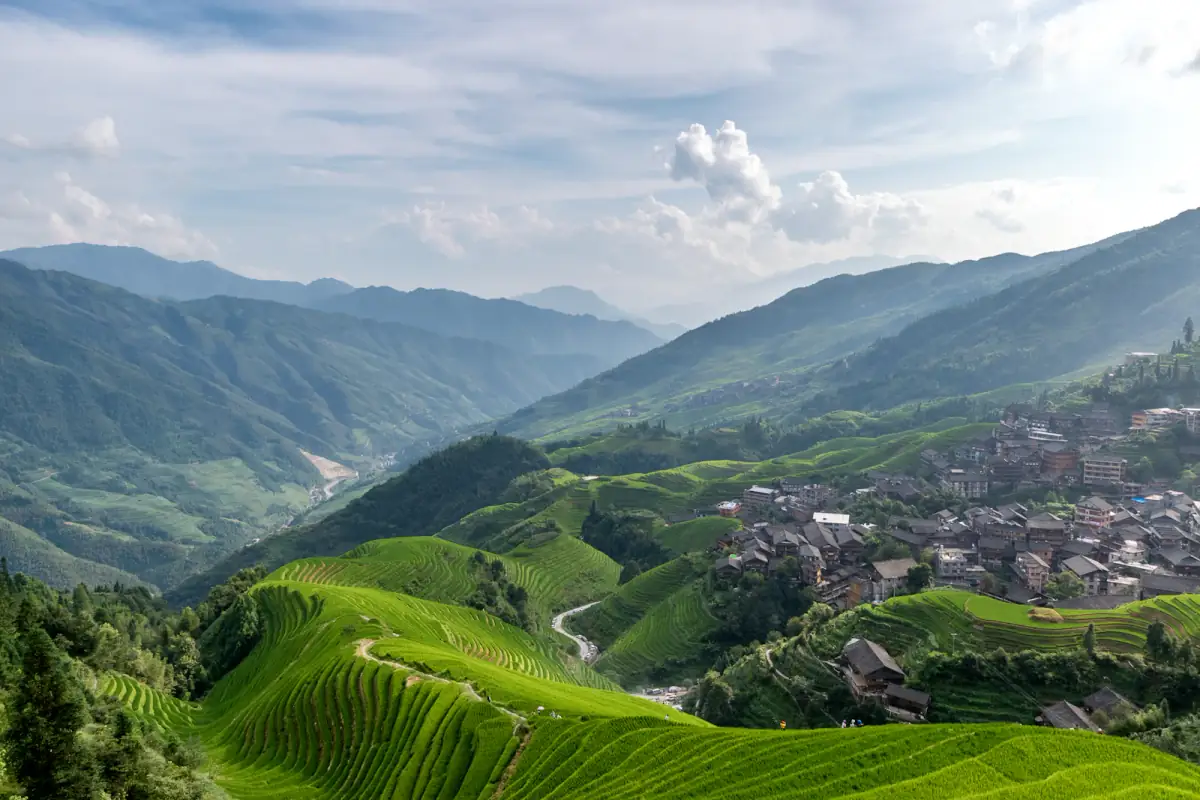
Use a long stay to earn optionality. Four nights in Beijing can hold both an imperial-axis day and a Great Wall day while leaving room for weather. Several nights near Zhangjiajie can separate high viewpoints from forest walking. Three nights around Guilin and Yangshuo can support a river plan and a rural fallback. These are not empty luxuries; they are how landscape-dependent travel becomes reliable.
Open-jaw geography and the no-loop rule
Where flight options permit, arrive in one gateway and depart from another. A Beijing-to-Shanghai, Beijing-to-Chengdu, or Shanghai-to-southwest line avoids spending a precious day retracing the route. The domestic sequence should look like a line or shallow arc on the map. A loop is justified only when transport connections genuinely make it simpler.
Evaluate every proposed stop by its exit as well as its entrance. A mountain region may be magnificent but poorly connected to the next city. A famous destination that requires a flight plus two long road transfers can consume the buffer it was supposed to enrich. Two weeks allows one complex transition, not several. Put the hardest transfer before a multi-night base so a delay does not collide with another checkout.
Excursions that deepen the route
Choose excursions that reveal a different scale without adding luggage. From a major city, a garden, water town, mountain section, archaeological site, or conservation area can widen the story while the same hotel holds the trip together. The excursion should have a clear bad-weather substitute and should not be scheduled on the morning after the route's longest transfer.
An overnight side trip earns its place only when early morning or late evening changes the experience. Suzhou after day-trippers leave, Yangshuo outside the central streets, or a mountain base near the park can justify the move. If the value exists equally as a day trip, keep the main hotel and reduce the number of check-ins.
Recovery, laundry, and decision fatigue
By the second week, the limiting factor is often decision fatigue rather than distance. Schedule a late start, laundry window, familiar breakfast, and an evening without a cross-city target. Put that recovery near the middle, before the most scenic or expensive section, so the trip's strongest days are not experienced while exhausted.
Keep one backup payment method, one offline map workflow, and one compact document file consistent throughout the trip. Changing apps, hotels, and transport systems repeatedly increases failure risk. A two-week itinerary can be ambitious in landscape and culture while remaining conservative in logistics. That combination is what makes the added range enjoyable.